Furnace Limit Switch Replacement Cost in 2026, and What Made It Trip
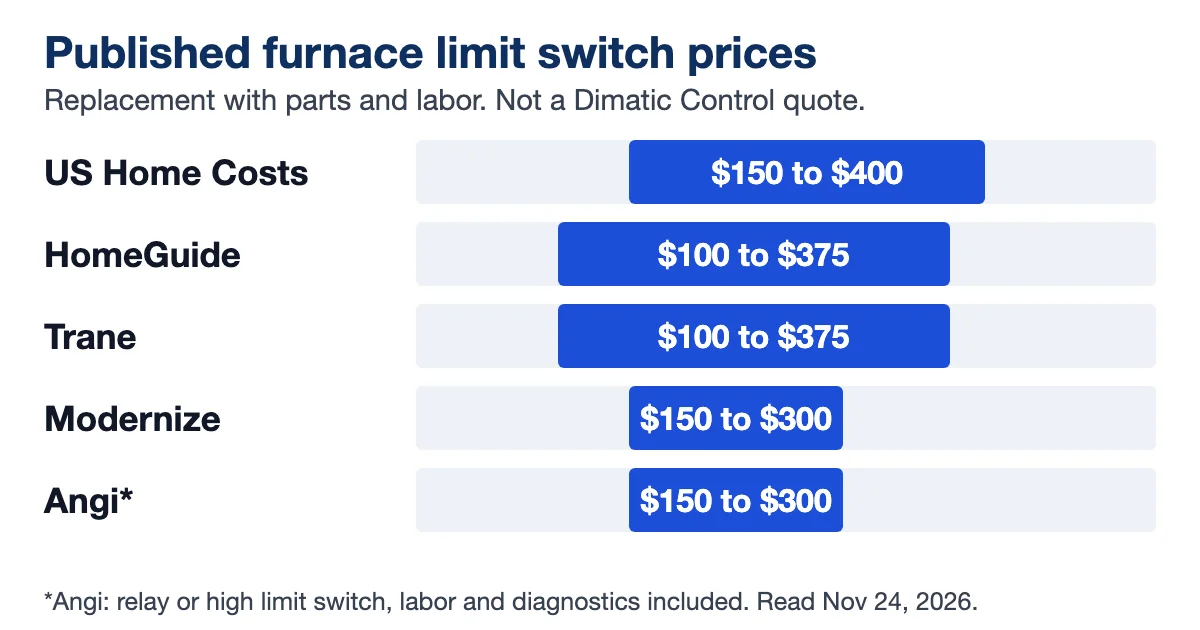
Replacing a furnace limit switch costs $100 to $400 with parts and labor in five national cost guides, and the three factory switches we priced sell for about $11. The switch is often not the real problem. It shuts the burners off when the furnace overheats, most often because too little air is moving across the heat exchanger. Before paying for a new switch, ask what tripped it.
Quick answer (checked November 24, 2026)
- Typical price, installed: $150 to $400 (US Home Costs); $100 to $375 (HomeGuide, Trane); $150 to $300 (Modernize, and Angi for a relay or high limit switch).
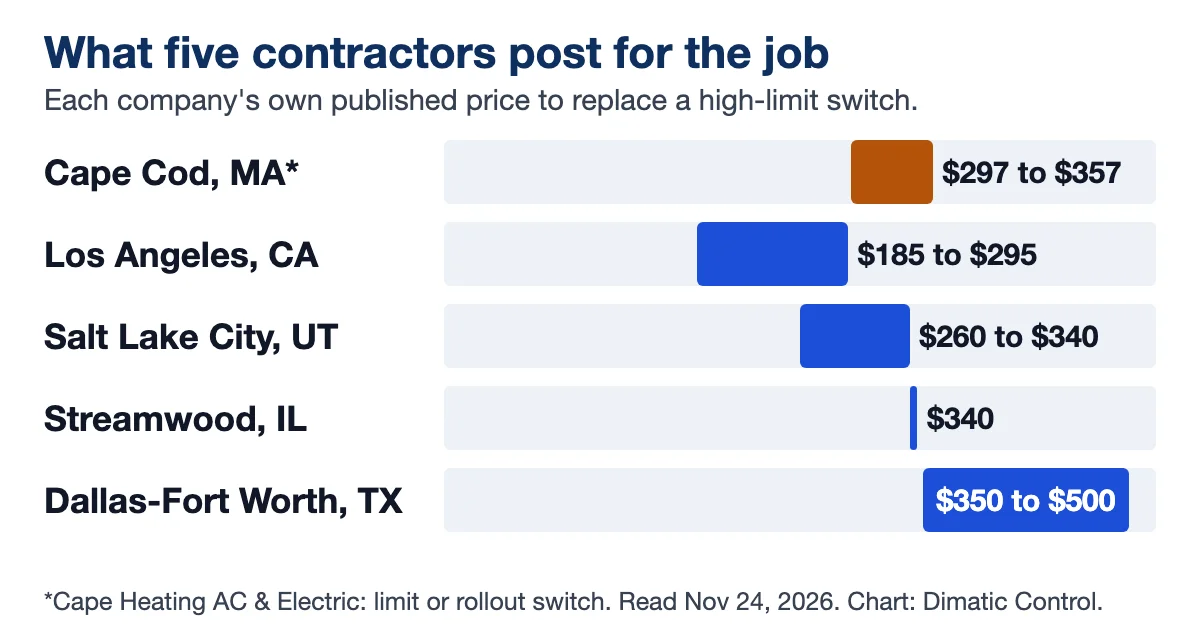
- Contractors' own prices: $185 to $500 for a high-limit switch in four states, and $297 to $357 for a limit or rollout switch on Cape Cod, the only Northeast price we found.
- The part: $10.54 to $11.43 for three factory switches we priced (Repair Clinic, SupplyHouse).
- Diagnostic fee: $50 to $200 on average (Trane); four of the contractors below list $75 to $110 in regular hours and credit or waive it when you approve the repair.
- Never: bypass the switch or adjust its factory setting (Carrier, Goodman).
National and out-of-state figures, not a New Jersey price and not a Dimatic Control quote.
What You Are Paying For
Most of the bill is the visit, not the part. A Carrier main limit switch was $11.43 at SupplyHouse, a Carrier flame rollout limit switch $11.03 at Repair Clinic, and a Goodman-Amana auto limit switch $10.54 (SupplyHouse, out of stock that day). Angi puts the part at $5 to $20 (Angi).
US Home Costs breaks its estimate down by type of switch (US Home Costs):
- Standard high-limit switch: $20 to $80 for the part, $150 to $300 installed.
- Electronic limit switch: $30 to $100 for the part, $175 to $350 installed.
- Combination fan-limit switch: $30 to $120 for the part, $175 to $375 installed.
- Specialty or less common switch: $50 to $150 for the part, $225 to $450 installed.
The rest is diagnosis and labor. Trane says a service call fee averages $50 to $200 and that some companies may apply it toward the repair (Trane). One guide sits far below the others: Fixr lists $66 to $122, and around $90 for a service call and a new limit switch at the low end (Fixr). Treat that as the floor, not the usual bill.
The new switch also has to be the right one. A limit switch opens at a set temperature (the Goodman part above is sold as a 130 to 160°F switch), and US Home Costs notes that correct selection, electrical connections, temperature ratings and safety testing all require HVAC knowledge. Goodman's manual is blunt: "DO NOT ADJUST THE LIMIT CONTROL (FACTORY SET)" (Goodman).
What Contractors Charge, in Their Own Words
Cost guides average many jobs. These five contractors post their own price for the whole replacement:
- Cape Cod, Massachusetts: $297 to $357 for a limit or rollout switch, standard parts and labor (Cape Heating AC & Electric, reviewed August 2026). The only Northeast price we found.
- Los Angeles: $185 to $295 flat rate, parts and labor, with an $89 diagnostic ($149 after hours) credited to the repair (Venta Heating and Cooling).
- Salt Lake City: $260 to $340 for a high limit switch and $290 to $360 for a flame rollout switch, typical prices rather than fixed ones, with the $110 diagnostic already credited (Canyon Comfort, prices updated October 2026).
- Streamwood, Illinois: $340 for a high limit switch and $325 for a flame rollout switch, flat rate with parts and labor; the $75 diagnostic ($99 evenings, weekends and holidays) is waived when you approve the repair (Pure Comfort, updated November 9, 2026).
- Dallas-Fort Worth: $350 to $500 all-inclusive for a complete high-limit switch repair, with an $85 diagnostic waived if you approve the repair (Frosty's HVAC, October 15, 2026).
A quote far above these ranges deserves a question: is it for the switch alone, or for the switch plus whatever made it trip? A quote far below them deserves one too: did anyone check why it tripped?
Main Limit, Auxiliary Limit or Rollout: Which One Tripped?
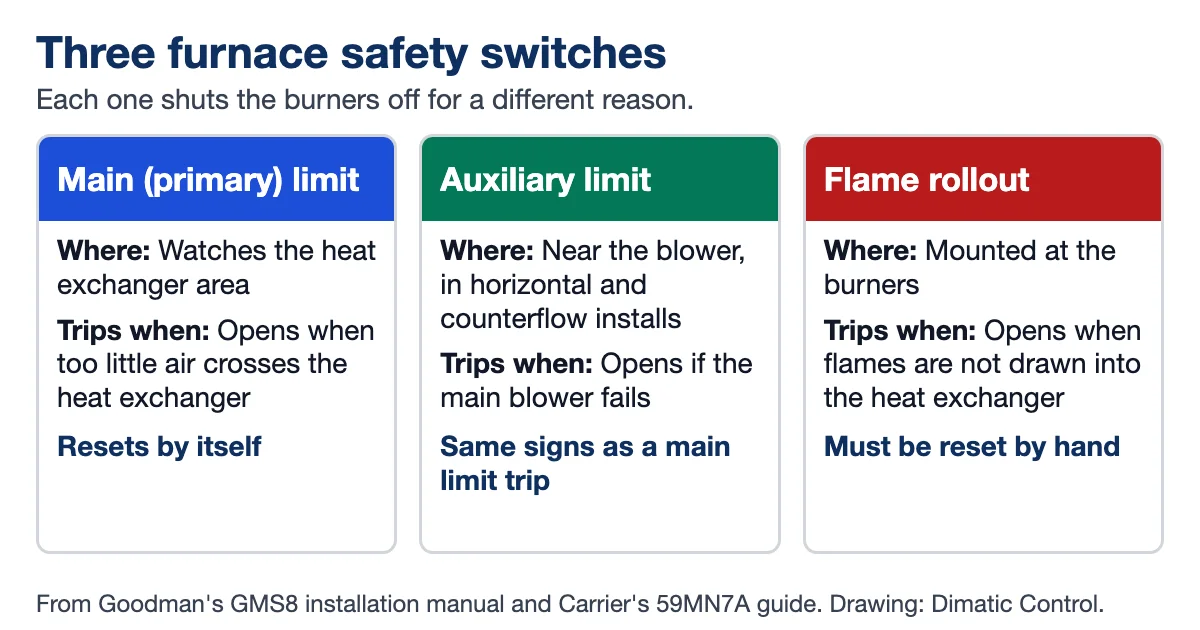
A gas furnace can have three kinds of temperature safety switch, and each one points to a different problem. Goodman's installation manual describes all three (Goodman):
- Main (primary) limit: monitors the heat exchanger compartment, resets by itself, and guards against overheating caused by too little air passing over the heat exchanger.
- Auxiliary limit: sits on or near the blower on horizontal and counterflow installations and stops the furnace if the main blower fails. When it opens, the blower keeps running and the symptoms are identical to a main limit trip.
- Flame rollout switch: mounted at the burners, manual-reset, and there to catch burner flames that are not being drawn into the heat exchanger.
The furnace usually tells you which one opened. On Goodman's GMS8 furnaces, four flashes of the control light mean the primary limit circuit is open, and six flashes cover a rollout trip. On Carrier's 59MN7A, status code 33 means the limit or flame rollout switch is open, and code 13 is a lockout after the switch stays open more than 3 minutes or trips 10 times in a row at maximum heat (Carrier); our pages on Carrier code 33 and Carrier code 13 walk through those. On Lennox communicating systems, code 200 means the rollout limit switch is open (our Lennox code guide covers the neighboring codes), and a primary limit that stays open three minutes puts the unit in a 60-minute soft lockout (Lennox). Codes differ by model, so read the label on your own furnace door.
Why Limit Switches Trip, and What the Real Fix Can Cost
A limit switch is a messenger. One Los Angeles contractor puts it plainly: a limit switch almost never fails on its own; it trips because the furnace really overheated (Venta). HVAC School makes the same point about safety switches in general: they don't just fail for no reason (HVAC School).
The manufacturers list the usual causes of a main limit trip:
- A dirty filter or blocked ducts. Goodman names "blocked filters, restrictive ductwork, improper circulator blower speed, or failed circulator blower," and calls a blocked or dirty filter one of the most common causes of a problem in a forced air heating system (Goodman).
- A blower problem. Carrier's code 33 checklist starts with a loose blower wheel (Carrier), and Goodman lists a failed circulator blower. If the blower motor itself has failed, our blower motor replacement cost guide covers that repair.
- Too much gas for the airflow. Carrier also lists an improper gas input adjustment (Carrier).
- The switch itself. Carrier lists an improper limit switch or a missing limit gasket, and a defective switch or connections (Carrier).
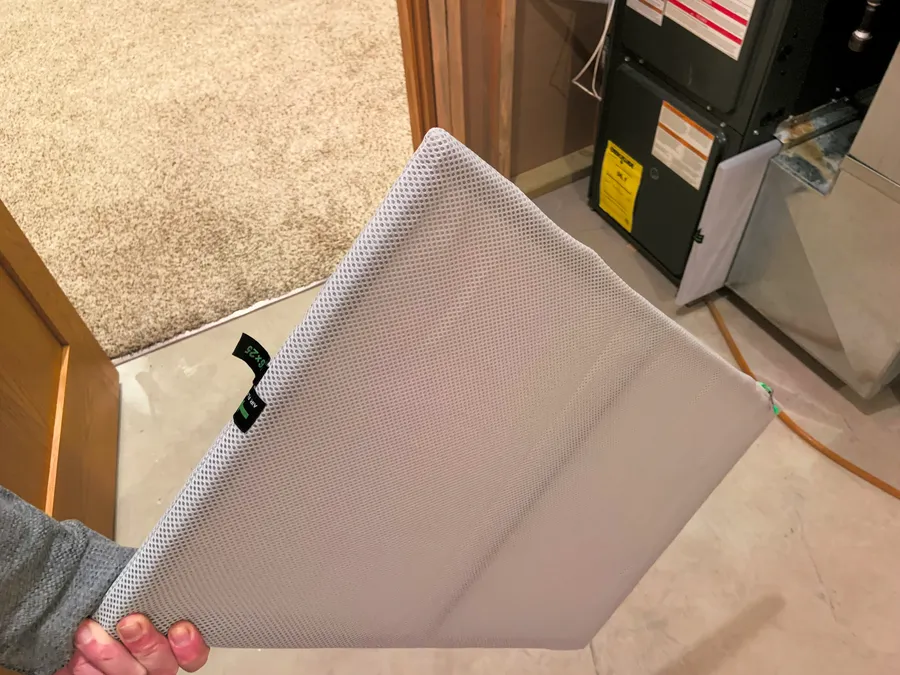
The cheapest fix comes first. The U.S. Department of Energy says to clean or replace furnace filters once a month or as recommended (Energy Saver), ENERGY STAR says to inspect, clean or change them once a month (ENERGY STAR), and Goodman says filters must be inspected monthly and cleaned or replaced every two months or as required. Also check that supply registers and return grilles are open and not covered by furniture.
There is one more reason to fix the cause: repeated trips wear the switch out. HVAC School says a furnace running near the top of its temperature range may begin cycling on the limit control, which is not designed to shut the furnace on and off regularly and will eventually fail (HVAC School). A new switch on a furnace that still overheats is likely to trip again.
The Check That Decides It: Temperature Rise
Temperature rise is the difference between the air going into the furnace and the heated air coming out. Every gas furnace's rating plate gives an allowed range, such as 50 to 80 or 45 to 75 degrees, and the rise must be within it (HVAC School). Goodman's manual says the rise is set per the rating plate and that the blower speed may need changing to reach it (Goodman).
- Rise above the range: too little air is crossing the heat exchanger. The switch is doing its job; the filter, blower or ducts need the work.
- Rise inside the range, switch still opening: the switch is suspect. A technician confirms it with a continuity test on a meter (the test the Repair Clinic listing describes).
Ask for the return temperature, the supply temperature and the range printed on your rating plate. Those three numbers show whether you are paying for a switch or for an airflow problem.
Rollout Switch Tripped? Treat It as a Warning
A rollout trip is different from a main limit trip. It means flame was outside the heat exchanger where it should not be. HVAC School notes that blocked combustion chambers, blocked flue pipes and cracked heat exchangers may cause flame rollout (HVAC School), and Goodman lists misaligned burners, a blocked flue or air inlet pipe, and a failed draft inducer (Goodman).
Carrier's instruction is direct: do not bypass the switch, and correct the combustion-air supply or the failed component before resetting it (Carrier). Lennox says to correct the cause of the rollout trip and check for a blocked or obstructed vent pipe (Lennox). If a rollout switch trips more than once, stop pressing the reset and have the venting and the heat exchanger inspected. Our guide to a cracked heat exchanger explains that inspection. The Consumer Product Safety Commission recommends a professional inspection of the heating system every year, including chimneys and flues (U.S. CPSC).
Can You Replace or Reset It Yourself?
Changing the filter is yours to do. The switch is another matter. US Home Costs says correct selection, electrical connections, temperature ratings and safety testing require HVAC knowledge, and that professional replacement is generally recommended because the limit switch is an important furnace safety control (US Home Costs). Two rules hold either way:
- Never jumper, bypass or adjust a limit or rollout switch (Carrier, Goodman).
- A main limit resets on its own once the furnace cools; a rollout switch has to be reset by hand, after the cause is fixed.
Limit Switch Trips in Union County
Gas heats 82.9% of occupied homes in Union County, against 74% in New Jersey and 46.6% nationally (U.S. Census Bureau, ACS 2024), so most homes here heat with gas, and a gas furnace carries the switches this guide covers. The housing is also older: the median home in Union County was built in 1957, against 1971 for New Jersey and 1981 nationally (U.S. Census Bureau, ACS 2024). Whatever the age of the house, a temperature-rise reading is the check worth asking for before you pay for a switch.
Dimatic Control's gas furnace repair team works across Union County, including furnace repair in Union. When you call, tell us the code or number of flashes, whether the blower keeps running after the burners go out, and when the filter was last changed, and have the model number from the rating plate inside the furnace door ready.
Furnace Shutting Off on a Limit Code?
Dimatic Control provides gas furnace repair across Union County. Call or send a quote request and tell us what the furnace is doing.
Furnace Limit Switch: Frequently Asked Questions
How much does it cost to replace a furnace limit switch?
Five national cost guides put it between $100 and $400 with parts and labor: $150 to $400 (US Home Costs), $100 to $375 (HomeGuide and Trane), and $150 to $300 (Modernize, and Angi for a relay or high limit switch). Five contractors that post their own prices charge $185 to $500. These are published figures read November 24, 2026, not a Dimatic Control quote.
How much is a furnace limit switch by itself?
Two Carrier switches we priced were $11.03 (Repair Clinic) and $11.43 (SupplyHouse), and a Goodman-Amana switch was $10.54 (SupplyHouse). Angi puts the part at $5 to $20, and US Home Costs puts a standard high-limit switch at $20 to $80. Most of the bill is the visit, the diagnosis and the labor.
What causes a furnace limit switch to trip?
Usually too little air across the heat exchanger. Goodman's manual lists blocked filters, restrictive ductwork, the wrong blower speed and a failed blower, and Carrier's guide adds a loose blower wheel and a wrong gas input setting. A flame rollout switch trips for different reasons: Goodman names misaligned burners, a blocked flue or air inlet pipe and a failed draft inducer.
Can I reset a furnace limit switch?
A main limit resets by itself once the furnace cools (Goodman). A flame rollout switch has to be reset by hand, and Carrier says to correct the cause before resetting it. If a rollout switch trips again, stop resetting it and have the venting and heat exchanger checked.
Can I bypass a furnace limit switch?
No. Carrier's guide says not to bypass the rollout switch, and Goodman's manual warns not to adjust the factory-set limit control, to prevent premature heat exchanger failure, property damage, injury or death.
What is the difference between a limit switch and a rollout switch?
The main limit watches the heat exchanger compartment and opens when it overheats from too little air. The rollout switch sits at the burners and opens when flames are not drawn into the heat exchanger. HVAC School notes that a blocked flue or a cracked heat exchanger may cause flame rollout, which is why a rollout trip is treated as a warning.
How do I know if the limit switch itself is bad?
A technician checks two things. First, the temperature rise: if it is inside the range on the furnace's rating plate and the switch still opens, the switch is suspect. Second, the switch itself, with a continuity test on a meter (Repair Clinic's listing describes this test). HVAC School's point is that safety switches don't just fail for no reason, so the airflow check comes first.
How often should I change my furnace filter?
The U.S. Department of Energy says to clean or replace furnace filters once a month or as recommended, and ENERGY STAR says to inspect, clean or change them once a month. Goodman's manual says filters must be inspected monthly and cleaned or replaced every two months or as required.
Sources
Every price and technical figure on this page was read from the sources below on November 24, 2026. Prices are national or out-of-state market figures, not a Dimatic Control quote.
- US Home Costs, furnace limit switch replacement cost guide (editorial desk, updated October 30, 2026): Typical planning range $150-$400, national planning average about $275, national spread $100-$450; replacement switch alone about $20-$150; standard high-limit switch $20-$80 for the part and $150-$300 installed, with electronic, combination fan-limit and specialty switches priced separately; correct selection, electrical connections, temperature ratings and safety testing require HVAC knowledge, and professional replacement is generally recommended. Described as planning allowances, not guaranteed prices.
- HomeGuide, furnace repair cost (Sarah Noel, August 27, 2025): The cost to replace a limit switch on a furnace is $100 to $375; prices include materials and labor.
- Trane, average furnace repair cost (Anne Fonda, published September 11, 2024): Furnace limit switch $100-$375; a service call fee can average $50-$200, and some companies may apply it toward the repair cost.
- Modernize, furnace repair cost (Isabella Andersen, updated November 10, 2026): Limit switch $150 to $300; the prices by part are national averages and include parts and labor unless noted.
- Angi, average furnace repair cost (Paige Bennett, updated September 25, 2026): Relay and high limit switch repairs cost between $150 and $300 once labor and diagnostics are factored in; the part itself costs between $5 and $20.
- Fixr, furnace repair cost (Carol J. Alexander, updated August 29, 2025): Limit switch $66 to $122; on the low end, around $90 for a service call and a new limit switch. Far below the other guides read.
- Cape Heating AC & Electric, Cape Cod, Massachusetts (pricing last reviewed August 2026): Limit switch or rollout switch $297-$357; repair pricing includes standard parts and labor, and emergency or after-hours service may be priced differently.
- Pure Comfort Heating and Cooling, Streamwood, Illinois (updated November 9, 2026): High limit switch replacement $340 and flame rollout switch replacement $325, flat-rate prices including parts and labor; diagnostic or service call $75 regular hours, $99 evenings, weekends and holidays, waived when the repair is approved.
- Canyon Comfort, Salt Lake City, Utah (prices updated October 2026): High limit switch $260-$340 and flame rollout switch $290-$360, typical prices, not fixed, with the $110 diagnostic already credited; the final price depends on the diagnosis.
- Venta Heating and Cooling, Los Angeles, California (no date printed): Furnace high-limit switch replacement $185-$295, flat rate, parts and labor; a limit switch almost never fails on its own, it trips because the furnace overheated; $89 diagnostic ($149 after hours), credited to the repair.
- Frosty's HVAC, Dallas-Fort Worth, Texas (October 15, 2026): Complete high-limit switch repair service $350-$500 all-inclusive; the full-service high-limit switch repair covers an EPA-certified technician, parts, labor, testing and warranty; diagnostic $85, waived with the repair.
- Repair Clinic, Carrier furnace limit switch HH18HA499: $11.03; the listing describes it as a flame rollout limit switch and says to test it for continuity with a multimeter.
- SupplyHouse, Carrier HH18HA502 main limit switch: $11.43 each, in stock.
- SupplyHouse, Goodman-Amana B1370187 130-160F auto limit switch: $10.54 each, out of stock when read.
- Goodman GMS8/GDS8/GHS8 gas furnace installation and operating instructions (IO-242D, 2/06): The primary limit monitors heat exchanger compartment temperatures, resets automatically and guards against overheating from insufficient air over the heat exchanger; the rollout limits are manual-reset and guard against flames not being drawn into the heat exchanger; the auxiliary limit, on or near the blower, prevents operation if the main blower fails on horizontal and counterflow installations, and its symptoms are identical to a primary limit trip; do not adjust the factory-set limit control; four flashes mean the primary limit circuit is open, with insufficient air from blocked filters, restrictive ductwork, improper circulator blower speed or a failed circulator blower; six flashes cover a rollout, with misaligned burners, a blocked flue or air inlet pipe, or a failed induced draft blower; a blocked or dirty filter is one of the most common causes of a problem in a forced air heating system; filters must be inspected monthly and cleaned or replaced every two months or as required; temperature rise is set per the rating plate, and the blower speed may need changing to reach it.
- Carrier 59MN7A series troubleshooting guide (form 59MN7A-01T): Status code 33, limit circuit fault: the limit or flame rollout switch is open; check for a loose blower wheel, a defective switch or connections, improper minimum- or maximum-heat gas input adjustment, a dirty filter or restricted duct system, and an improper limit switch or no limit gasket. Status code 13, limit circuit lockout, when the switch is open longer than 3 minutes or after 10 successive limit trips during maximum heat; the control resets after 3 hours. The flame rollout switch requires manual reset: do not bypass the switch, and correct inadequate combustion-air supply or component failure before resetting it.
- Lennox residential communicating systems alert code guide (V2, form 100017, 3/2023): Code 200, rollout limit switch open: correct the cause of the rollout trip and check for a blocked or obstructed vent pipe. When the primary limit switch is not closed within three minutes, the unit goes into a 60-minute soft lockout.
- HVAC School, furnace air temperature rise (Bryan Orr, December 26, 2022): Temperature rise is the difference between return and heated supply air and must be within the range on the rating plate, shown like 50-80 or 45-75 degrees; near or over the top of the range the furnace may begin cycling on the limit control, which is not designed to shut the furnace on and off regularly and will eventually fail.
- HVAC School, gas furnaces: what a tech needs to know (Bryan Orr, March 3, 2023): Blocked combustion chambers, blocked flue pipes and cracked heat exchangers may also cause flame rollout.
- HVAC School, HVAC overloads and safety switches don't just fail (Bryan Orr, June 6, 2022): Safety switches such as float switches and thermal overloads don't just fail for no reason.
- U.S. Department of Energy, Energy Saver guide (2022): Clean or replace filters on furnaces once a month or as recommended.
- ENERGY STAR, heating and cooling maintenance checklist: Inspect, clean or change air filters once a month in a central air conditioner, furnace or heat pump.
- Elizabethtown Gas, odor of gas: Alert others and leave the area immediately, leaving the door open; avoid anything that may cause a spark, including starting a car engine and using cell phones or light switches; go to a phone away from the area and call 1.800.492.4009.
- PSE&G, I smell gas: Immediately exit the building and move at least 350 feet away; once at a safe distance, call 1-800-880-7734 or 911.
- U.S. Consumer Product Safety Commission, carbon monoxide questions and answers: If a CO alarm sounds, do not try to find the source; move outside to fresh air, call emergency services, the fire department or 911, and do not go back in until responders give permission. Have the heating system professionally inspected and serviced annually, including chimneys and flues.
- U.S. Census Bureau, American Community Survey 2024 1-year, table B25040 (house heating fuel), via Census Reporter: Utility gas heats 170,828 of 206,050 occupied homes in Union County (82.9%), 74% in New Jersey and 46.6% nationally.
- U.S. Census Bureau, American Community Survey 2024 1-year, table B25035 (median year structure built), via Census Reporter: Median year built: Union County 1957, New Jersey 1971, United States 1981.
Related Guides
Gas Furnace Repair
Diagnosis and repair across Union County
Furnace Blower Motor Replacement Cost
When the blower, not the switch, is the failed part
Cracked Heat Exchanger
What a rollout trip can point to, and how it is tested
Furnace Pressure Switch Replacement Cost
The other safety switch that stops a furnace from lighting