Furnace Pressure Switch Replacement Cost in 2026, and How to Know the Switch Is Really the Problem
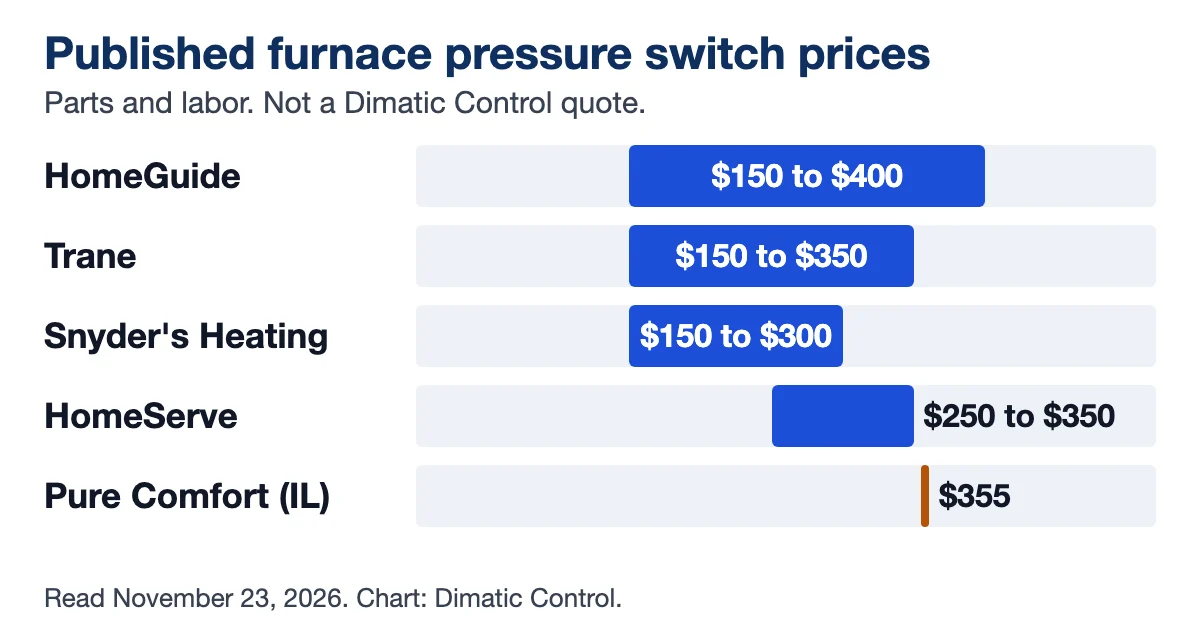
Replacing a furnace pressure switch typically costs $150 to $400 with parts and labor (HomeGuide), and the switch itself is $30 to $200 across the three part ranges we read. A pressure switch code does not prove the switch has failed: it can be reporting a blocked vent, a clogged drain, a bad hose or a weak inducer motor. Before paying for a new switch, ask for the draft reading that proves it.
Quick answer (checked November 23, 2026)
- Typical price: $150 to $400 installed (HomeGuide); $150 to $350 (Trane); $250 to $350 (HomeServe).
- The part: $30 to $200 across HomeGuide, Snyder's and HomeServe.
- Diagnostic fee: $50 to $150, typically applied to the labor when the work is done (HomeGuide).
- Proof it is the switch: the inducer runs, the measured draft is above the point where the switch should close, and the switch still stays open (Ferguson, cfm Distributors).
- How long one lasts: about 10 years (HomeGuide), or 5 to 10 years (Snyder's).
National and out-of-state figures, not a New Jersey price and not a Dimatic Control quote.
What a Pressure Switch Replacement Bill Is Made Of
The switch is a small part, and the labor to find the fault can cost more than the part. HomeServe's split shows it plainly: $30 to $50 for the switch and $220 to $300 for the labor to diagnose and replace it.
| Line item | Range | Source |
|---|---|---|
| The switch (part) | $50 - $200 | HomeGuide |
| The switch (part) | $30 - $120 | Snyder's |
| The switch (part) | $30 - $50 | HomeServe |
| Labor to replace it | $100 - $200 | HomeGuide, Snyder's |
| Diagnosis and replacement labor together | $220 - $300 | HomeServe |
| Diagnostic fee | $50 - $150 | HomeGuide; typically applied to the labor |
Sources: HomeGuide, Snyder's Heating & Cooling and HomeServe.
HomeGuide names what moves the price: the furnace model, local labor rates, a separate diagnostic fee, emergency service outside regular hours, and other repairs found along the way. Snyder's adds access: a furnace in a tight space, or one where other parts must come off to reach the switch, can take more labor.
Five Published Prices, Side by Side
Three of the five figures start at $150. HomeServe's starts at $250, and its labor figure includes the diagnosis. Pure Comfort's flat rate of $355 sits inside HomeGuide's range and above the top of the other three.
HomeGuide: $150 - $400
April 24, 2025. Part $50 - $200, labor $100 - $200.
Trane: $150 - $350
Published September 11, 2024; page updated February 2, 2026. From its list of furnace repair costs, which it calls estimates only.
HomeServe: $250 - $350
August 15, 2025. Switch $30 - $50, diagnosis and replacement labor $220 - $300.
Snyder's Heating & Cooling (Ohio contractor): $150 - $300
March 22, 2026. Part $30 - $120, labor $100 - $200.
Pure Comfort (Illinois contractor): $355
Reviewed November 9, 2026. One company's flat rate with parts and labor.
A Pressure Switch Code Is Not a Diagnosis
Before the burners light, a small fan called the inducer pulls air through the furnace and out the vent. The pressure switch proves that pull is strong enough. If it is, the switch closes and the start-up goes on. If it is not, the furnace stops and locks out (Ferguson).
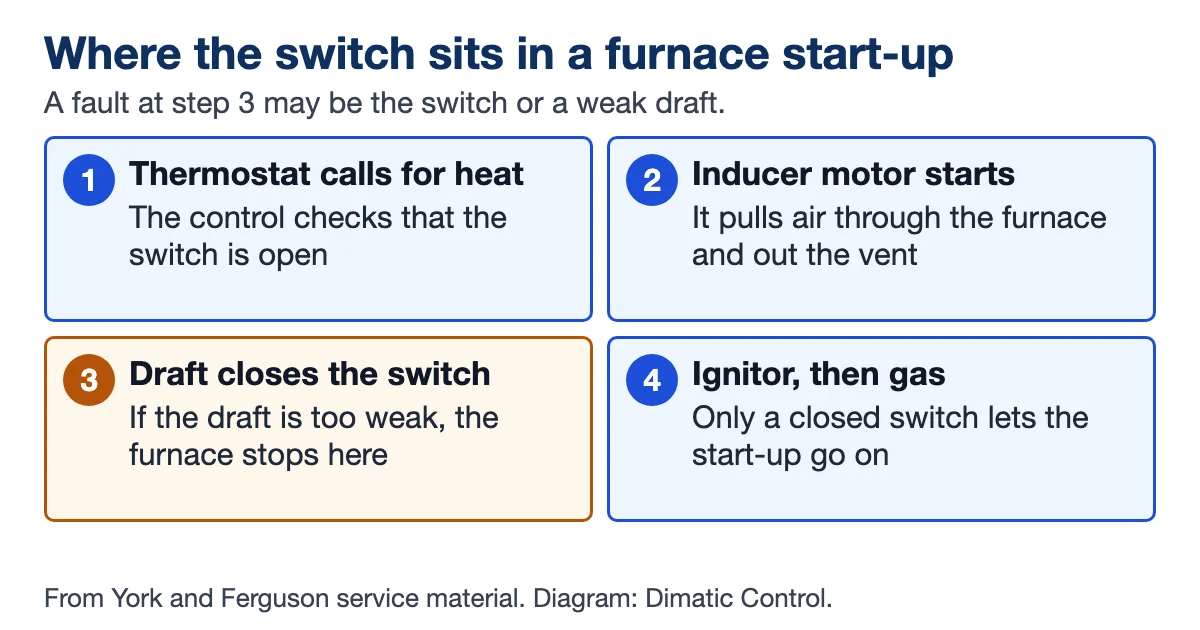
So a "did not close" code tells you the draft was not proven. It does not say why. In the words of HVAC distributor cfm, a flashing pressure switch code "doesn't mean that the pressure switch has failed," and the switch should not be replaced until troubleshooting shows that it has (cfm Distributors). Pure Comfort, an Illinois contractor, goes further and says the switch itself is rarely the problem (Pure Comfort).
These are the codes that point at the switch on common brands, as Pure Comfort lists them. Check them against the fault code chart for your own furnace model.
| Brand | Code |
|---|---|
| Carrier, Bryant, Payne | 31, 32, 43 (did not close); 23 (did not open) |
| Goodman, Amana, Daikin | 3 flashes (will not close); 2 flashes (stuck closed) |
| Trane, American Standard | 3 blinks |
| Lennox | 223 / E223 |
On a Carrier furnace, our Carrier code 31 guide walks through that code.
What the Fault Can Turn Out to Be, and What Each Fix Costs
Pure Comfort publishes flat rates for the common repairs behind a pressure switch code, which makes it a useful example of how the bill changes with the cause. These are one Illinois company's prices as of November 2026, with parts and labor. They are not New Jersey prices or a Dimatic Control quote.
| Repair | What it addresses | Flat rate |
|---|---|---|
| Pressure switch hose replacement | A cracked or loose hose leaks, so the switch cannot sense the inducer's pull. | $250 |
| Condensate trap cleaning or replacement | On a condensing furnace, a clogged trap lets water back up and cut the draft. | $290 |
| Condensate drain line flush and clear | A blocked drain line has the same effect, further down the line. | $290 |
| Pressure switch replacement | A torn or stiff diaphragm, or worn contacts inside the switch. | $355 |
| Condensate pump replacement | Water that cannot leave the furnace backs up into it. | $435 |
| Flue or PVC vent pipe repair | For example, a vent pipe that sags and holds water. | $435 |
| Inducer motor replacement | A weak motor may still spin but cannot pull enough draft to close the switch. | $570 - $1,410 |
Prices: Pure Comfort. Causes: Ferguson, cfm Distributors and the GUH92C service manual.
Pure Comfort publishes no price for simply clearing a blockage such as a nest, leaves or snow, so the vent line above is for repairing the pipe. And if water drips out when the hose comes off the switch, that is a condensate drainage problem, not a reason to buy a hose (Ferguson).
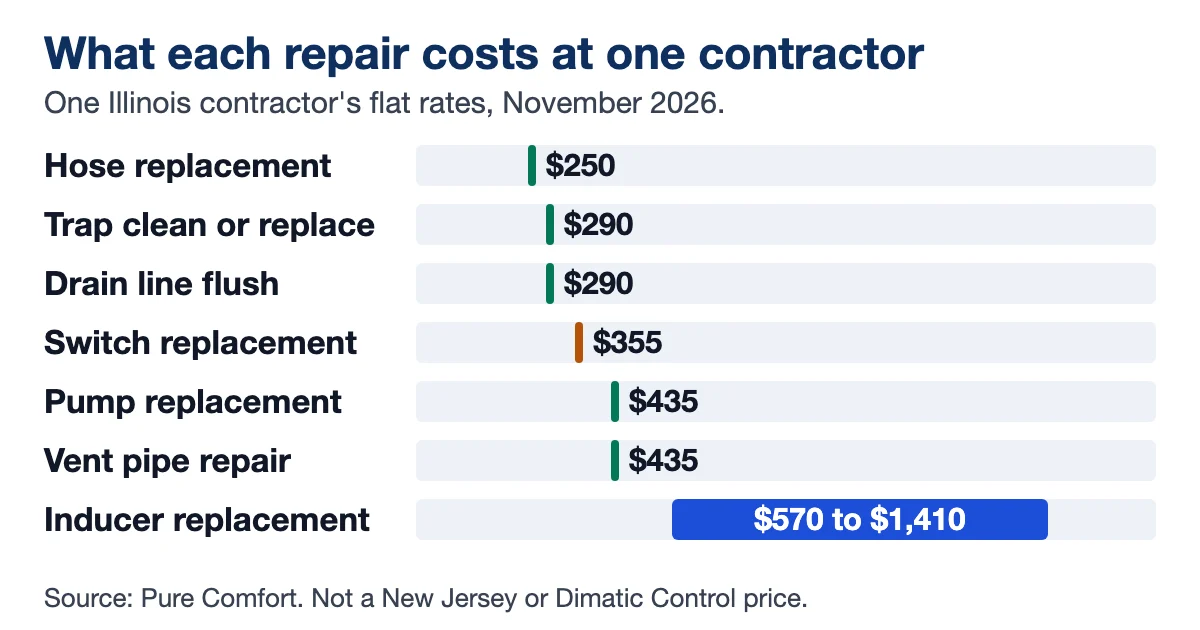
The most expensive item on the list is the inducer motor. Trane lists $400 to $1,100 for one (Trane), and our inducer motor cost guide covers how a technician confirms it.
A fault that comes and goes deserves a look at the drain. HVAC School describes a partly clogged condensate trap that drains while the furnace is locked out, so the furnace runs normally after a reset until the water backs up again (HVAC School). If your furnace also keeps starting and stopping, our furnace short cycling guide covers the other causes.
The Reading That Proves the Switch Failed
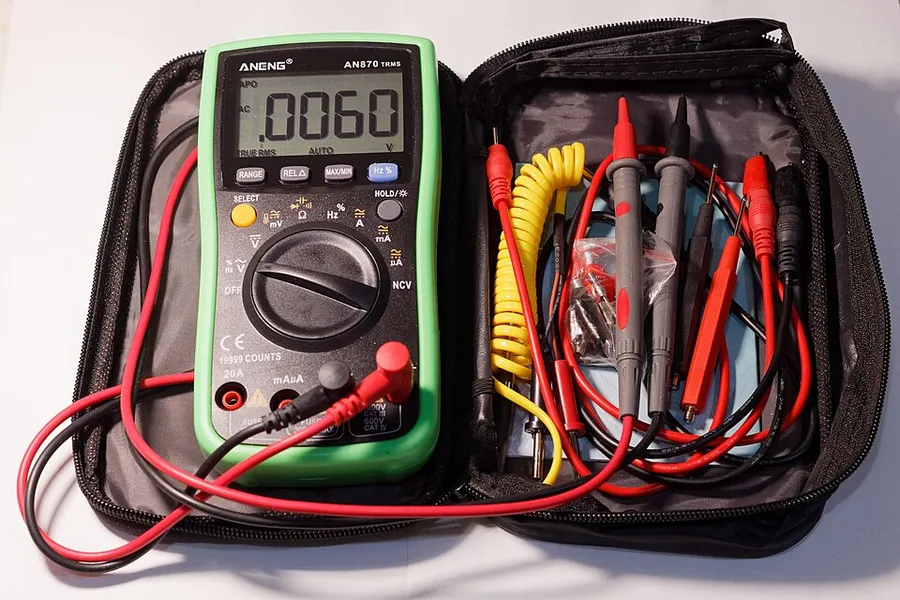
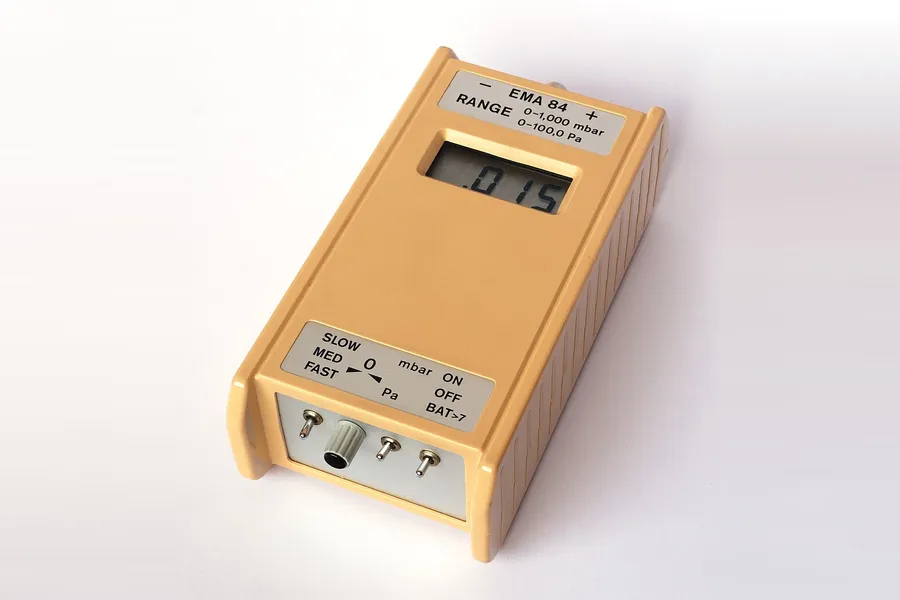
A technician can settle this with a multimeter and a manometer, a gauge that measures small air pressures in inches of water column. These are the steps, drawn from the trade guides:
- Watch the inducer. If it does not start, or hums and struggles to turn, the problem is the motor, its capacitor or the control board, not the switch (Ferguson).
- Inspect the hose. Look for cracks, kinks, dry rot, a loose fit or water inside (Ferguson).
- Check the voltage at the switch. With the inducer at full speed, 24 volts on the incoming terminal and 0 volts on the outgoing one means the switch is open (Ferguson).
- Measure the draft. The manometer is teed into the switch's hose, because the switch has a small bleed hole that can mislead a reading taken without the tee (cfm Distributors). One furnace service manual calls for a reading right after start-up and a second after about 5 minutes (GUH92C manual).
- Compare it with the number on the switch. The rating is usually printed on the switch. cfm notes that a switch closes slightly above that rating: one rated 0.80 inch closes at about 0.95 inch (cfm Distributors).
How to read the result
- Enough draft, switch still open: if the reading is above the point where the switch should close and it stays open, the switch has failed. Replace it (Ferguson, cfm Distributors).
- Not enough draft: the switch is doing its job. A new one will not fix it. The cause has to be found first. It can be in the vent, the drain, the inducer, the hose or its connection port, or another furnace component (Ferguson, cfm Distributors, GUH92C manual). On a furnace that draws its air from inside the house, negative air pressure in a tightly sealed home can also keep the switch from proving draft (Ferguson).
- Water in the hose: a drainage problem (Ferguson). If there is water inside the switch body, cfm says that switch should be replaced too (cfm Distributors).
What You Can Safely Check Before You Call
If you do not smell gas and no alarm is sounding, Pure Comfort lists three checks a homeowner can safely make:
- Clear snow and ice from the intake and exhaust pipes by hand.
- Check that the condensate pump is plugged in and not full.
- Reset the power once.
If the code comes back, stop there. Never jumper or bypass the switch to get heat back. Ferguson calls that defeating a critical life-safety device, with a severe risk of carbon monoxide exposure (Ferguson).
Five Questions Before You Approve a New Switch
- What did the manometer read, and what rating is printed on the switch?
- Did you check the hose, the vent and, on a high-efficiency furnace, the condensate trap and drain?
- Is the replacement the furnace's original part or a universal one? Ferguson says setting a universal switch takes extreme precision, and that many contractors prefer the exact original.
- Does the diagnostic fee come off the price if I approve the repair?
- What warranty covers the part, and what covers the labor?
Pressure Switch Faults in Union County
Gas heats 82.9% of occupied homes in Union County, against 74.0% in New Jersey and 46.6% nationally (U.S. Census Bureau, ACS 2024), so most homes here depend on gas heating equipment. Winter adds one more cause to rule out. Ferguson names heavy snow and ice at the vent among the causes of a blocked exhaust, and one technical bulletin for condensing furnaces lists vent ends below the expected snow line among the problems to inspect (TIC2017-0001). After a storm, if your furnace vents through plastic pipes in a side wall, look at them before you assume a part has failed.
Dimatic Control's gas furnace repair team works across Union County, including furnace repair in Union. When you call, tell us the code or number of flashes, whether you hear the inducer start, and whether anything changed after snow, and have the furnace brand and model number ready: it is on the rating plate inside the furnace door.
Furnace Showing a Pressure Switch Code?
Dimatic Control provides gas furnace repair across Union County. Call or send a quote request and tell us what the furnace is doing.
Furnace Pressure Switch: Frequently Asked Questions
How much does it cost to replace a furnace pressure switch?
HomeGuide puts it at $150 to $400 with parts and labor. Trane lists $150 to $350, Snyder's Heating & Cooling $150 to $300 and HomeServe $250 to $350. These are published figures read November 23, 2026, not a Dimatic Control quote.
How much does a pressure switch for a gas furnace cost by itself?
The three part ranges we read are $50 to $200 (HomeGuide), $30 to $120 (Snyder's) and $30 to $50 (HomeServe). In HomeServe's figures most of the bill is labor and diagnosis, at $220 to $300.
Does a pressure switch code mean the switch is bad?
No. cfm Distributors says a pressure switch fault code does not mean the switch has failed, and not to replace it until troubleshooting shows that it has. Pure Comfort, an Illinois contractor, says the switch itself is rarely the problem and names blocked vent pipes, a clogged condensate trap, a cracked or water-filled hose and a weak inducer motor as the usual causes.
What are the symptoms of a failed furnace pressure switch?
HomeGuide lists no heat, short cycling, a furnace that will not turn on, and clicking sounds as the furnace tries to start. A vent, drain or inducer problem can stop the furnace at the same step, so these signs call for a test before a new switch.
How do you know if a pressure switch is bad on a furnace?
A technician runs the inducer and measures the draft with a manometer teed into the switch's hose. Ferguson's rule: if the draft is greater than the switch's required set point and the switch stays open, the switch has failed. cfm Distributors adds that a switch closes about 0.15 inch above its stated setting, so the reading has to clear that point. If the draft falls short, the cause is elsewhere, such as the vent, the drain, the inducer, the hose or its connection port, or another furnace component, and a new switch will not fix it.
Can you reset a furnace pressure switch?
Snyder's says a pressure switch typically cannot be manually reset, and that resetting power alone rarely fixes the underlying issue. HVAC School explains why a furnace can seem fixed after a reset: a partly clogged condensate trap can drain while the furnace is locked out, then back up again.
Can a furnace run without a pressure switch?
It should never be made to. Ferguson says bypassing a pressure switch defeats a critical life-safety device and puts people at severe risk of carbon monoxide exposure. Pure Comfort says never to jumper or bypass one, because it is there to keep exhaust gases out of the home.
Can a furnace pressure switch be repaired?
HomeServe says repair usually is not an option because the switch is a calibrated safety device. Ferguson calls it a sealed, factory-calibrated part that must be replaced as a unit when its diaphragm or contacts fail.
How long does a furnace pressure switch last?
HomeGuide says about 10 years with proper maintenance. Snyder's says around 5 to 10 years, depending on usage, maintenance and system conditions.
Can I replace a furnace pressure switch myself?
Pure Comfort does not recommend it, because in most cases the switch is correctly reporting a venting, drain or inducer problem that a new switch will not fix. Ferguson adds that a universal switch set to the wrong pressure can create a dangerous operating condition.
Sources
Every price and technical figure on this page was read from the sources below on November 23, 2026. Prices are national or out-of-state market figures, not a Dimatic Control quote.
- HomeGuide, furnace pressure switch cost (Tamatha Hazen, April 24, 2025): $150-$400 total; part $50-$200; labor $100-$200; a $50-$150 diagnostic fee, typically applied to the labor when the service is performed; a switch generally lasts about 10 years with proper maintenance; signs include no heat, short cycling, a furnace that will not turn on and clicking sounds.
- Trane, average furnace repair cost (published September 11, 2024; page updated February 2, 2026): Furnace pressure switch $150-$350; inducer motor $400-$1,100; described as estimates only.
- HomeServe, furnace pressure switch replacement cost (Laure Justice, August 15, 2025): Switch $30-$50; labor for diagnosis and replacement $220-$300; total $250-$350; a stuck or failing switch usually needs complete replacement rather than repair.
- Snyder's Heating & Cooling, Ohio (March 22, 2026): Part $30-$120; labor $100-$200; on average $150-$300; a pressure switch typically cannot be manually reset; about 5 to 10 years of life; most modern furnaces will not ignite if the switch detects a problem.
- Pure Comfort Heating and Cooling, Streamwood, Illinois (reviewed November 9, 2026): Flat-rate prices with parts and labor as of November 2026: pressure switch hose replacement $250, condensate trap cleaning or replacement $290, condensate drain line flush and clear $290, pressure switch replacement $355, condensate pump replacement $435, flue or PVC vent pipe repair $435, inducer motor replacement $570-$1,410; $75 diagnostic, $99 evenings, weekends and holidays, waived when the repair is approved; pressure switch codes by brand; the switch itself is rarely the problem; never jumper or bypass a pressure switch.
- Ferguson, furnace pressure switch troubleshooting guide: How the switch proves draft; inducer, voltage and manometer tests; adequate draft with an open switch means the switch failed; replacing the switch will not fix a draft problem; a backed-up condensate drain is one of the most frequent causes; never bypass the switch; universal switches need precise setting and many contractors prefer the exact original part.
- cfm Distributors, operating and troubleshooting furnace pressure switches (Paul Flora, September 27, 2017; archived copy, because the original address no longer loads): A pressure switch code does not mean the switch has failed; do not replace it until troubleshooting shows a failed switch; a switch closes at about 0.15 inch above its stated setting (a 0.80-inch switch closes at about 0.95 inch); the manometer must be teed into the tubing because of the switch's bleed hole; a switch with water in it should be replaced.
- HVAC School, properly diagnosing a gas furnace pressure switch (Justin Skinner, February 4, 2019): The switch proves the inducer is working and the exhaust path is clear; on a 90%+ furnace a partly clogged condensate trap can keep the switch from closing, and the water may drain while the furnace is locked out, so it runs fine after a reset until the water backs up again.
- GUH92C gas furnace service manual: If the condensate line is blocked, water backs up into the header box and reduces the pressure across the switch; a lack of pressure differential usually indicates problems in the intake or exhaust piping but may indicate other components; take one reading right after start-up and a second at steady state, about 5 minutes.
- Technical bulletin TIC2017-0001, Code 31 inspection sheet for 35-inch condensing gas furnaces (via Sigler): Lists vent terminations below the anticipated snow line, and frozen vent or combustion air pipes, among the installation problems to inspect on a code 31.
- Elizabethtown Gas, odor of gas: Alert others and leave the area immediately, leaving the door open; avoid anything that may cause a spark, including starting a car engine, cell phones and light switches; go to a phone away from the area; do not try to locate the source.
- PSE&G, gas leaks and emergencies: Immediately exit the building and move at least 350 feet away; once at a safe distance, call 1-800-880-7734 or 911.
- U.S. Consumer Product Safety Commission, carbon monoxide questions and answers: If a CO alarm sounds, do not try to find the source; move outside to fresh air, call emergency services, the fire department or 911, and do not go back in until responders say so.
- U.S. Census Bureau, American Community Survey 2024 1-year, table B25040 (house heating fuel), via Census Reporter: Utility gas heats 170,828 of 206,050 occupied homes in Union County (82.9%), 74.0% in New Jersey and 46.6% nationally.
Related Guides
Gas Furnace Repair
Diagnosis and repair across Union County
Furnace Inducer Motor Replacement Cost
When the fan that makes the draft is the failed part
Furnace Control Board Replacement Cost
When the board, not the switch, is at fault
Gas Furnace Won't Ignite
The other common reasons a furnace will not light