Whole-House Humidifier Installation Cost in 2026: Bypass, Fan-Powered and Steam
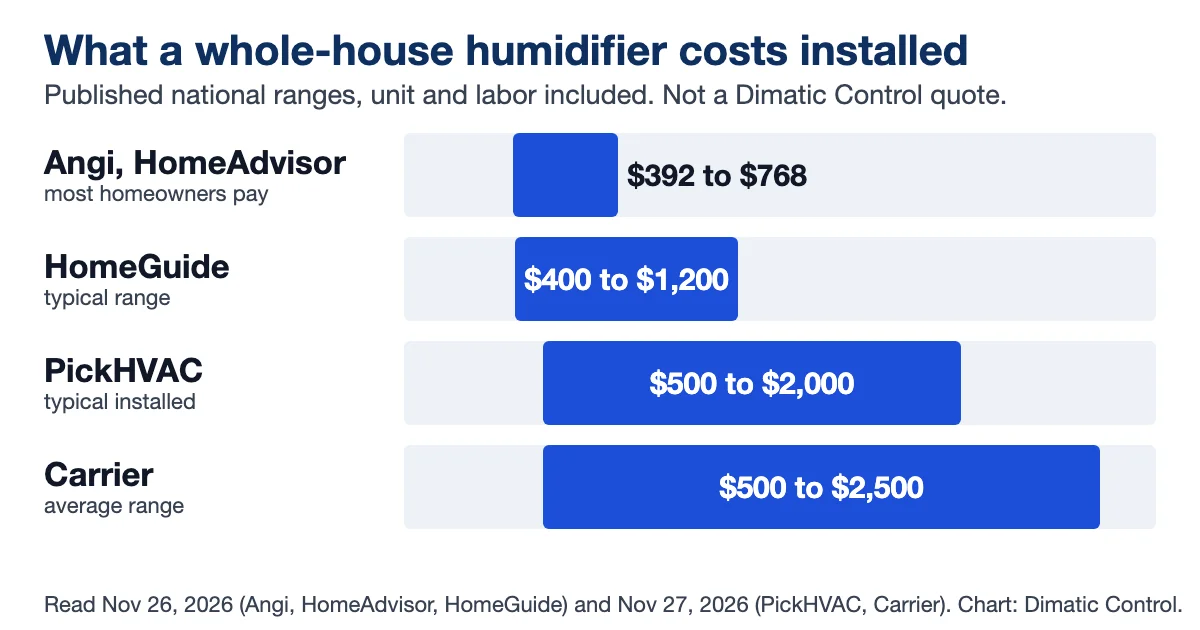
A whole-house humidifier costs $400 to $1,200 installed in HomeGuide's cost guide, and Angi and HomeAdvisor put the national average at $580, with most homeowners paying $392 to $768 for the unit and labor. Steam units cost the most: $500 to $2,200 installed in HomeGuide's guide and $1,200 to $2,500 in Carrier's. Where your job lands depends on the type, the water and drain run, and whether a steam unit needs a new circuit.
Quick answer (checked November 26 and 27, 2026)
- Installed, any type: $392 to $768, average $580 (Angi, HomeAdvisor); $400 to $1,200, average $750 (HomeGuide); $500 to $2,000, average near $1,100 (PickHVAC); $500 to $2,500 (Carrier).
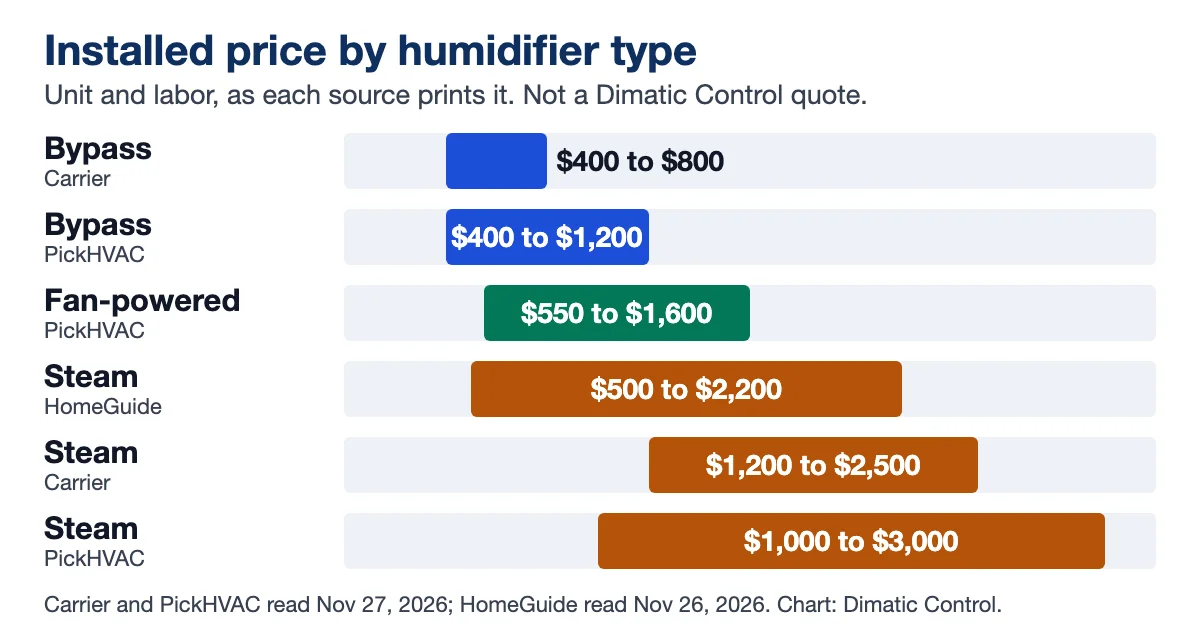
- Bypass: $400 to $800 installed (Carrier); $400 to $1,200 (PickHVAC).
- Fan-powered: $550 to $1,600 installed (PickHVAC).
- Steam: $500 to $2,200 (HomeGuide), $1,200 to $2,500 (Carrier), $1,000 to $3,000 (PickHVAC). It needs a dedicated circuit, which HomeGuide prices at $250 to $900; HomeGuide does not say whether its steam range includes it.
- Each year after: a water panel ($16.99 for Aprilaire's No. 35) or a steam canister ($109.99 for its No. 80), and a maintenance visit at $75 to $200 (Angi) or $70 to $150 (HomeGuide).
National figures, not a New Jersey price and not a Dimatic Control quote. Call for a free estimate on your own house.
Installed Price by Humidifier Type
Cost guides sort humidifiers two ways, and it helps to know both. Bypass and fan-powered describe how air moves through the unit: a bypass unit relies on the furnace blower and a duct connection, and a fan-powered unit has its own blower (HomeAdvisor). Drum and flow-through describe how the pad gets wet, and either kind can be bypass or fan-powered (Angi). Steam units heat water into steam with electricity and are priced on their own. The table keeps each source's own labels and says whether a figure is the unit alone or the installed job.
| Type | Unit only | Installed (unit and labor) | Source |
|---|---|---|---|
| Bypass | not given | $400 to $800 | Carrier |
| Bypass | not given | $400 to $1,200 (average $750) | PickHVAC |
| Fan-powered | not given | $550 to $1,600 (average $1,000) | PickHVAC |
| Drum | $100 to $300 | $200 to $750 | HomeGuide |
| Drum | $100 to $300 | not given | Angi, HomeAdvisor |
| Flow-through | $100 to $500 | $200 to $950 | HomeGuide |
| Flow-through | $200 to $600 | not given | Angi, HomeAdvisor |
| Steam | $300 to $1,300 | $500 to $2,200 | HomeGuide |
| Steam | $300 to $1,100 | not given | Angi, HomeAdvisor |
| Steam | not given | $1,200 to $2,500 | Carrier |
| Steam | not given | $1,000 to $3,000 (average $1,800) | PickHVAC |
Angi's and HomeAdvisor's tables label the drum row "Drum (bypass)", while both say in their text that drum units can be bypass or fan-powered. HomeAdvisor says its type prices are for the unit alone. PickHVAC calls its figures broad U.S. estimates and puts the unit alone at $150 to $1,500 across types.
Aprilaire Prices by Model
Aprilaire's product pages for the 600, 700 and 800 show no price; the units are sold through its network of contractors. HomeGuide lists these unit prices, before labor (HomeGuide):
| Aprilaire model | Unit price | Gallons per day | Up to (sq. ft.) |
|---|---|---|---|
| 500 small bypass | $130 to $200 | 12 | 3,500 |
| 400 water saver bypass | $170 to $300 | 17 | 5,000 |
| 600 large bypass | $150 to $250 | 17 | 5,000 |
| 700 fan-powered | $250 to $350 | 18 | 5,300 |
| 800 steam and 865 ductless steam | $700 to $1,000 | 11.5 to 34.6 | 10,000 |
Aprilaire's own pages give the same figures for the 600 (17 gallons a day for tightly constructed homes up to 5,000 square feet) and the 700 (18 gallons a day, up to 5,300) (Model 600, Model 700). For the 800 steam unit, its product page says up to 34.6 gallons a day, while its FAQ gives 11.5, 20.5 or 23.3 gallons a day at 110, 208 or 240 volts (Model 800, Aprilaire FAQ). Aprilaire's FAQ also describes the 400 as drain-free. For scale, Angi says a well-sealed 1,500-square-foot home needs about 3.2 gallons a day, and larger homes may need twice that (Angi).
What Changes the Price of the Job
The unit is only part of the bill. Angi says a proper install takes extensive knowledge of plumbing, HVAC and electrical work, and puts labor at $100 to $1,000, at $50 to $150 an hour; some companies add a service fee of $100 to $200 (Angi). HomeGuide puts labor at $100 to $900 and HVAC rates at $75 to $150 an hour (HomeGuide). These are the parts of the job that move a quote up or down:
- The water line. HomeGuide lists a water connection for drum, flow-through and steam units alike (HomeGuide). This Old House's steam install runs a new copper cold-water supply line from the water heater to the humidifier (This Old House), and PickHVAC lists a long water-line run among the things that push a quote toward the high end (PickHVAC).
- The drain. HomeGuide says flow-through and steam humidifiers need water, electrical and drain lines, while drum units need water and electrical but no drain line. Aprilaire's Model 400 is a drain-free bypass unit (Aprilaire FAQ). PickHVAC puts a short connection to an approved nearby drain at $40 to $150, and extending a line or fixing poor drainage at $150 to $500 or more.
- A dedicated circuit for steam. HomeGuide says steam humidifiers require a dedicated electrical circuit and prices one at $250 to $900. PickHVAC puts a new circuit, panel work or a long cable route at $300 to $1,000 or more. This Old House has a licensed electrician run a new 220-volt circuit for its steam unit.
- The duct bypass. Bypass models need suitable supply and return duct locations; if the furnace cabinet or ductwork has no room, PickHVAC says rerouting or sheet-metal changes can add roughly $150 to $600 or more. HomeGuide says bypass models can go on the return or supply duct, and fan-powered units usually go on the supply duct.
- Where the furnace sits. PickHVAC says a cramped attic or crawl space may add 10% to 25% to labor compared with an open utility room, and Angi says hard-to-reach closets and attics can add to the total.
- Timing with a new furnace. HomeGuide says humidifiers are easiest to install when the furnace is being replaced but can be added to an existing furnace, and Carrier says installing one with a new furnace or heat pump may simplify the job (Carrier). Our furnace replacement cost guide covers that larger project.
Your Heating System Decides Which Types Fit
- Gas or oil furnace: HomeGuide calls a flow-through unit typically the best choice for an average-size home, and says bypass models are not recommended for modulating furnaces because of the furnace's low fan speed (HomeGuide).
- Heat pump: HomeGuide says steam humidifiers are best, because a heat pump's air is not hot enough to run a drum or flow-through unit effectively. Our heat pump cost guide covers the system itself.
- Boiler, radiators or baseboard heat: Aprilaire's bypass and fan-powered models are made for ducted HVAC systems (Aprilaire). Aprilaire says its Model 800 steam unit works in homes with ducted air systems with or without forced air heat, for example ducts that serve central air (Aprilaire), and that its Model 300 can be used in homes with mini-splits, boilers, radiant heat and other ductless systems (Aprilaire FAQ). This Old House shows a ductless steam system whose fan pack spreads the moisture without ductwork (This Old House). See our boiler services for the heating side of those homes.
What It Costs to Run and Maintain
Bypass and fan-powered units add little to the electric bill; steam units typically use more, because they heat water with electricity (Bryant). The published yearly energy costs:
- Angi: drum $1 to $3, flow-through $9 to $28, steam $150 to $500 a year (Angi).
- HomeGuide: bypass $1 to $3, fan-powered $9 to $28, steam $150 to $480 a year (HomeGuide).
- Aprilaire, Model 800 steam: about 25 cents an hour at 240 volts, which comes to about $3.00 a day or $90.00 a month if it ran 12 hours a day, and about 10 cents an hour at 120 volts. Aprilaire calls 12 hours a day unlikely, and it does not state the electricity rate behind these figures (Aprilaire FAQ).
The parts and service that come back each year:
- Water panel or pad: Aprilaire says to replace it annually on Models 300, 500, 600, 700 and 720, and twice per heating season on the Model 400 (Aprilaire). Its No. 35 panel, listed for models including the 600 and 700, is $16.99 on Aprilaire's store (Aprilaire). Cost guides put pads at $10 to $50 a year (Angi), $10 to $50 including installation (HomeAdvisor) and $10 to $20 (HomeGuide).
- Steam canister: replace it and its O-ring every year, and have a licensed contractor replace the electrode wires every three years (Aprilaire). Aprilaire's No. 80 canister for Models 800, 801, 865 and 866 is listed at $109.99 (Aprilaire).
- Water down the drain: on Aprilaire's 500 and 600 bypass units, the drain flow fills a quart jar in about five minutes; on the fan-powered 700, in about two and a half minutes (Aprilaire FAQ).
- Maintenance visit: $75 to $200 (Angi) or $70 to $150 (HomeGuide). Bryant recommends including the humidifier in the annual HVAC check-up (Bryant); our furnace tune-up cost guide covers that visit.
- Repairs and life span: repairs average around $230 and can reach $500 for whole-house units (Angi); HomeGuide gives $70 to $400. Angi and HomeAdvisor give a life of 10 to 15 years, and HomeGuide 10 to 15 years or more if properly installed and well maintained.
How Much Humidity to Aim For in a New Jersey Winter
More is not better, and the published targets differ:
- U.S. EPA: keep indoor humidity between 30 and 50 percent (EPA); its mold guide says below 60 percent, ideally 30 to 50 (EPA).
- NDSU Extension: 30 to 40 percent in winter; above about 40 percent raises the potential for condensation on windows and other cool surfaces (NDSU).
- University of Minnesota Extension: 25% in winter to 50% in summer (UMN Extension).
- Aprilaire designs its humidifiers to hold 35% at 70°F indoors whenever it is 20°F or warmer outside (Aprilaire FAQ), while its product hub describes balanced humidity as 40 to 60% and says the outdoor temperature affects what a house can reach (Aprilaire). Modernize says many households feel best at around 40% to 50% (Modernize).
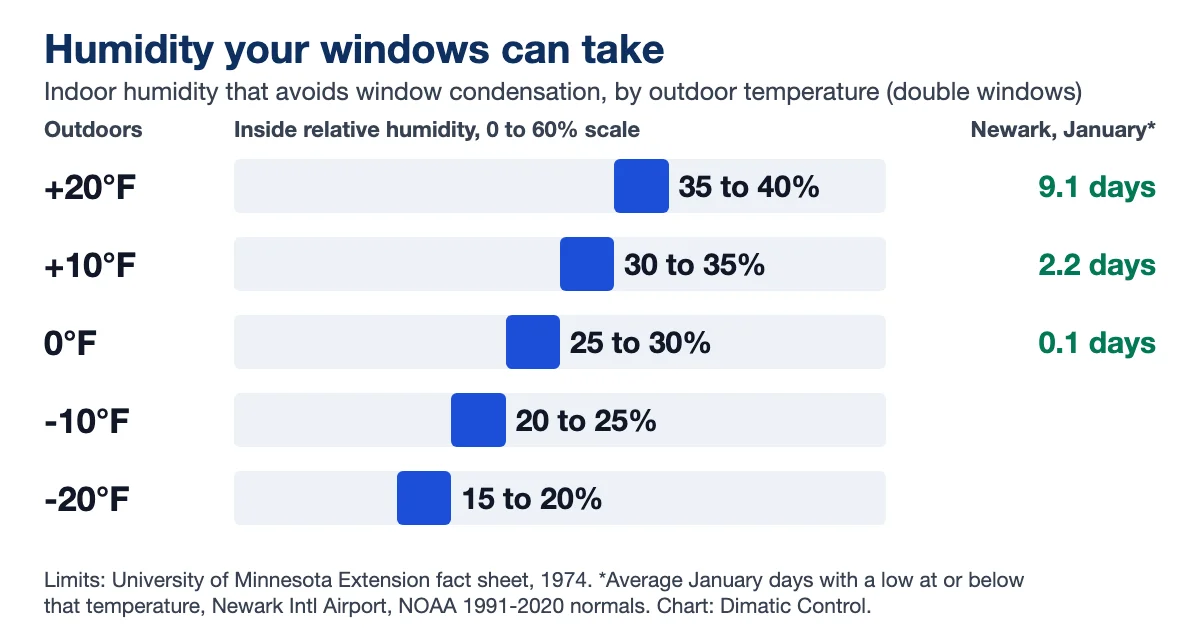
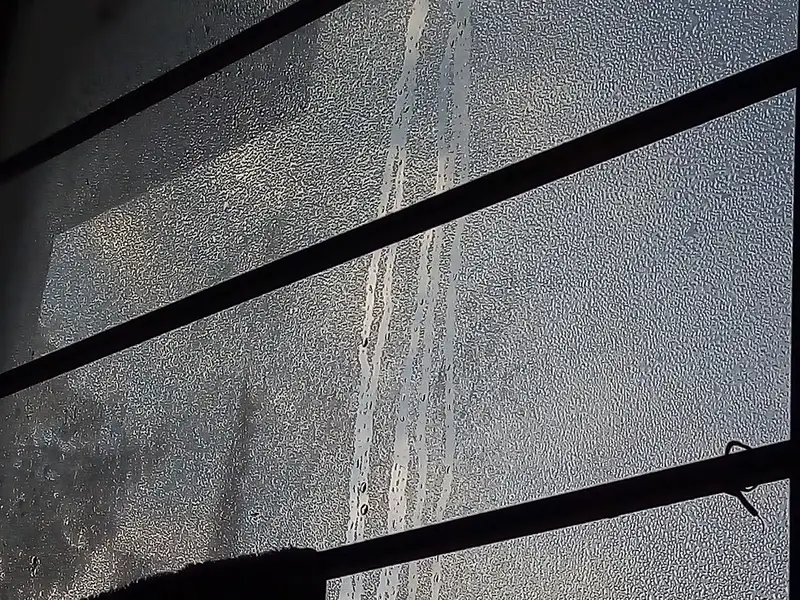
On a cold night the limit is the window glass. A 1974 University of Minnesota fact sheet lists the inside humidity a house with double windows can hold without window condensation: 35 to 40% when it is 20°F outside, 30 to 35% at 10°F, 25 to 30% at 0°F, and lower below that. It adds that regardless of what a humidity gauge says, window condensation must be the measure of a tolerable moisture level (Cloud and Bates, 1974).
Those cold nights happen here. At Newark Intl Airport, NOAA's 1991-2020 normals put the average January low at 25.5°F, with 9.1 days in an average January dropping to 20°F or below, 2.2 days to 10°F or below and 0.1 days to 0°F or below. February averages 6.0 such days at 20°F or below, and December 3.1 (NOAA, definitions in NOAA's documentation). On a 10°F night the 1974 limit is 30 to 35%, so a setting of 40% that suits a milder week can fog the glass. HomeGuide says automatic humidistats regulate humidity based on the current outside temperature (HomeGuide).
Measure before and after. HomeGuide prices a hygrometer at $10 to $70 and a humidistat at $30 to $50 for a manual model or $90 to $200 for an automatic digital one (HomeGuide), and the EPA puts a humidity meter at $10 to $50 (EPA).
Where the Published Figures Disagree
Some sources contradict themselves. Rather than pick one number, here are both:
- Bryant opens with $400 to $1,200 installed, based on pricing for Bryant installations, and later puts installation-related costs at about $400 to $1,500, covering the unit, labor and materials (Bryant).
- This Old House's ductless steam project lists a cost of $600 to $2,000 in its project box, while its text says the humidifier ranges from less than $200 to more than $1,000, with professional installation as a separate expense (This Old House). Its ducted steam project lists $650 to $850, plus installation (This Old House).
- HomeGuide's running costs: its summary says $10 to $250 a year, while its own table lists $1 to $3, $9 to $28 and $150 to $480 by type (HomeGuide).
- Aprilaire's Model 800 capacity: up to 34.6 gallons a day on the product page, 11.5 to 23.3 by voltage in the FAQ.
Before You Sign a Quote
Two quotes for "a humidifier" can describe different jobs. PickHVAC suggests asking for an itemized quote and checking these items (PickHVAC):
- The model number and its rated capacity, not just the total.
- Whether the humidistat or control, startup and testing are included.
- How the water line and drain will be routed.
- Whether a new electrical circuit is in the price.
- Duct changes, removal of an old unit, and the warranty.
On the warranty, HomeGuide notes that most brands require professional installation and registration within 60 to 90 days of purchase for the warranty to be valid (HomeGuide).
Getting a Humidifier Estimate in Union County
Dimatic Control's humidification service works across Union County, including humidifier installation in Union, as part of our indoor air quality work. When you call, tell us what heats the house (furnace, heat pump or boiler), whether it has ducts, where the furnace or air handler sits, whether a floor drain or utility sink is nearby, and the furnace model number from the rating plate. Those details help us estimate the right type.
Dry Air This Winter?
Dimatic Control provides whole-house humidifier installation across Union County. Call or send a quote request for a free estimate.
Whole-House Humidifier Cost: Frequently Asked Questions
How much does it cost to install a whole-house humidifier?
HomeGuide puts it at $400 to $1,200 installed, with a national average of $750. Angi and HomeAdvisor give a national average of $580, with most homeowners paying $392 to $768 for the unit and labor. Carrier gives $500 to $2,500 and PickHVAC $500 to $2,000. These are published national figures read November 26 and 27, 2026, not a New Jersey price and not a Dimatic Control quote.
Is a bypass or a steam humidifier cheaper to install?
Bypass. Carrier puts a bypass unit at $400 to $800 installed and a steam unit at $1,200 to $2,500. PickHVAC lists $400 to $1,200 for bypass and $1,000 to $3,000 for steam. A steam unit also needs a dedicated electrical circuit, which HomeGuide prices at $250 to $900.
Can I add a whole-house humidifier if I have a boiler or baseboard heat?
Aprilaire's bypass and fan-powered models are made for ducted HVAC systems. Aprilaire says its Model 800 steam unit works in homes with ducted air systems with or without forced air heat, for example ducts that serve central air, and that its Model 300 can be used in homes with mini-splits, boilers and radiant heat. This Old House shows a ductless steam unit that spreads moisture with a fan pack instead of ducts.
How much does a whole-house humidifier cost to run?
Angi puts yearly energy at $1 to $3 for a drum unit, $9 to $28 for flow-through and $150 to $500 for steam; HomeGuide's table gives $1 to $3 for bypass, $9 to $28 for fan-powered and $150 to $480 for steam. Add a water panel or pad each year ($16.99 for Aprilaire's No. 35) or a steam canister ($109.99 for Aprilaire's No. 80).
What humidity should I set in winter?
The EPA says to keep indoor humidity between 30 and 50 percent, and NDSU Extension recommends 30 to 40 percent in winter, noting that above about 40 percent raises the potential for condensation on windows. A 1974 University of Minnesota fact sheet lowers the limit as it gets colder: 35 to 40 percent at 20°F outside and 30 to 35 percent at 10°F. If the windows fog or frost, turn it down.
Does a whole-house humidifier need a drain?
Most do. HomeGuide says flow-through and steam humidifiers need water, electrical and drain lines, while drum humidifiers need water and electrical connections but not a drain line. Aprilaire's Model 400 is a drain-free bypass unit. PickHVAC puts a short drain connection at $40 to $150 and longer drain work at $150 to $500 or more.
What are the downsides of a whole-house humidifier?
Upkeep and moisture. Angi says drum units need a lot of maintenance to ward off mold, and HomeAdvisor says drum models carry a higher risk of mold growth. HomeGuide says flow-through models use more water than drum units, and Bryant says steam units typically use more electricity. Too much humidity is its own problem: a This Old House expert warns that in a tight, insulated house too much humidity can cause mold, and window condensation is the sign to turn it down.
How long does installation take?
HomeGuide says 2 to 6 hours: 2 to 3 hours for bypass and fan-powered units and 4 to 6 hours for steam. PickHVAC gives about 2 to 4 hours for a straightforward job next to an accessible furnace and 4 to 8 hours for a retrofit with new duct, water, drain or wiring work.
Sources
Every price and technical figure on this page was read from the sources below on November 26 and 27, 2026. Prices are national market figures, not a New Jersey price and not a Dimatic Control quote.
- Angi, how much does a whole-house humidifier cost (Lyle Hendriks, updated October 16, 2026): National average $580 based on 895 verified projects; most homeowners pay $392 to $768; costs can start as low as $175 or climb to $1,350 for high-end furnace-mounted units. By type: drum $100 to $300, flow-through $200 to $600 plus the cost of installation, steam $300 to $1,100, with installation raising the price further. Labor $100 to $1,000 at $50 to $150 an hour; some companies add a service fee of $100 to $200. Yearly energy: drum $1 to $3, flow-through $9 to $28, steam $150 to $500. Maintenance visits $75 to $200; repairs average around $230 and up to $500 for whole-house units; evaporative pads $10 to $50 a year; hygrometer $10 to $70; lasts 10 to 15 years.
- HomeAdvisor, how much does a whole-house humidifier cost in 2026 (staff writer, updated June 19, 2026): Average $580, range $392 to $768 including unit and labor. Units alone $100 to $1,100: drum $100 to $300, flow-through $200 to $600, steam $300 to $1,100; drum and flow-through units can be bypass or powered. Bypass units can trim $100 to $300 off the price. Steam operating costs and upkeep $150 to $500 a year; pads $10 to $50 including installation; repairs average $230, up to $500; lasts 10 to 15 years.
- HomeGuide, how much does a humidifier cost to install (Tara Farmer, July 14, 2025): $400 to $1,200 installed; national average $750, minimum $200, maximum $2,500. Unit and installed: drum $100 to $300 and $200 to $750, flow-through $100 to $500 and $200 to $950, steam $300 to $1,300 and $500 to $2,200. Aprilaire unit prices by model. Labor $100 to $900; HVAC services $75 to $150 an hour. A dedicated circuit costs $250 to $900, and steam units require one. Running cost table: bypass $1 to $3, fan-powered $9 to $28, steam $150 to $480 a year (its summary says $10 to $250). Maintenance $70 to $150; pads $10 to $20; repairs $70 to $400; hygrometer $10 to $70; humidistat $30 to $50 manual or $90 to $200 automatic. Install time 2 to 6 hours. Most brands require professional installation and registration within 60 to 90 days of purchase for the warranty to be valid.
- Carrier, whole house humidifier costs in 2026 (Travis Baugh, September 29, 2026): Average cost including installation ranges from $500 to $2,500; bypass units generally $400 to $800 installed; steam $1,200 to $2,500 installed. Steam may need additional electrical work; humidifiers generally need connections to the water supply and ductwork. Installing one with a new furnace or heat pump may simplify the job. Its lineup runs from up to 12 to up to 34 gallons per day.
- Bryant, whole house humidifier cost (Travis Baugh, no date printed): Typically $400 to $1,200 installed, according to pricing provided for Bryant installations; later on the same page, installation-related costs of about $400 to $1,500, covering the unit, labor and materials. Steam units typically use more electricity than bypass and fan-powered units. Recommends including the humidifier in the annual HVAC check-up.
- PickHVAC, HVAC humidifier installation cost and price ranges 2026 (Rene Langer, October 3, 2026): Typically $500 to $2,000 installed, average near $1,100, as broad U.S. estimates. Installed: bypass $400 to $1,200 (average $750), fan-powered $550 to $1,600 (average $1,000), steam $1,000 to $3,000 (average $1,800); unit only $150 to $1,500. Bypass duct rerouting or sheet-metal changes $150 to $600 or more; a new circuit, panel work or a long cable route $300 to $1,000 or more; a short drain connection $40 to $150, longer drain work $150 to $500 or more; a cramped attic or crawl space may add 10% to 25% to labor; about 2 to 4 hours for a straightforward job, 4 to 8 for a retrofit. Suggests an itemized quote listing the model, rated capacity, controls, startup, wiring, drain routing, removal and warranty.
- This Old House, how to install a whole house humidifier (Richard Trethewey, updated June 3, 2026): A steam humidifier added to a heat pump: cost $650 to $850, plus installation; 6 to 8 hours; a new copper cold-water supply line from the water heater, a drain line, a new 220-volt circuit run by a licensed electrician, and a humidistat set to approximately 35 or 40 percent.
- This Old House, how to install a whole-house ductless humidifier (Richard Trethewey, updated May 27, 2026): Its project box gives a cost of $600 to $2,000, while its text says the humidifier ranges from less than $200 to more than $1,000, with professional installation as a separate expense. The steam unit needs water, a drain and electricity on a dedicated circuit, and a fan pack spreads the moisture without ductwork.
- Aprilaire, frequently asked questions: Model 800 steam at 240 volts about 25 cents an hour, or about $3.00 a day and $90.00 a month at 12 hours a day, which it calls unlikely; at 120 volts about 10 cents an hour; no electricity rate stated. Model 800 capacity 11.5, 20.5 or 23.3 gallons a day at 110, 208 or 240 volts. Drain flow: about five minutes to fill a quart jar on the 500 and 600, two and a half minutes on the 700. The Model 400 bypass unit is drain-free. The Model 300 can be used in homes with mini-splits, boilers, radiant heat and other ductless systems. Humidifiers are designed to hold 35% at 70°F indoors whenever it is 20°F or warmer outside.
- Aprilaire, Model 600 large bypass humidifier: 17 gallons a day for tightly constructed homes up to 5,000 square feet; for ducted HVAC systems; available through Aprilaire's contractors, no price shown.
- Aprilaire, Model 700 fan-powered humidifier: 18 gallons a day for tightly constructed homes up to 5,300 square feet; for ducted HVAC systems; no price shown.
- Aprilaire, Model 800 steam humidifier: For homes in any climate with ducted air systems, with or without forced air heat; up to 34.6 gallons a day in a tightly constructed home; replace the canister every year and have a licensed contractor replace the electrode wires every 3 years; no price shown.
- Aprilaire, humidifier maintenance: Replace the water panel annually on Models 300, 500, 600, 700 and 720, or twice per heating season on the Model 400; replace the steam canister and O-ring annually; electrode wires every three years by a licensed contractor.
- Aprilaire store, No. 35 replacement water panel: $16.99; listed for models including the 600 and 700.
- Aprilaire store, No. 80 replacement steam canister: $109.99; for Models 800, 801, 865 and 866.
- Aprilaire, whole-house humidifiers: Balanced humidity exists between 40 and 60%, but outdoor temperature and other home factors affect what level is attainable and recommended.
- U.S. EPA, Care for Your Air (last updated August 17, 2026): Keep indoor humidity between 30 and 50 percent.
- U.S. EPA, a brief guide to mold, moisture and your home (last updated February 18, 2026): If possible, keep indoor humidity below 60 percent, ideally between 30 and 50 percent; a humidity meter costs $10 to $50.
- North Dakota State University Extension, measure humidity level (no date printed): The recommended winter humidity is 30 to 40 percent; above about 40 percent raises the potential for condensation on windows and other cool surfaces; below about 30 percent leads to dry skin and nasal passages.
- University of Minnesota Extension, controlling moisture problems in your home (2023): Relative humidity of 25% (winter) to 50% (summer) is generally considered healthy and comfortable for people and better for the house.
- University of Minnesota Agricultural Extension, Agricultural Engineering fact sheet No. 19 (H. A. Cloud and D. W. Bates, 1974): Table 1, allowable relative humidities to minimize condensation on windows in homes with double windows: -20°F outside 15 to 20%, -10°F 20 to 25%, 0°F 25 to 30%, +10°F 30 to 35%, +20°F 35 to 40%. Regardless of what a gauge says, window condensation must be the measure of a tolerable moisture level.
- Modernize, humidifiers and HVAC (Kate Pospisil, updated August 12, 2026): Many households feel best at around 40% to 50%; below 30% the air is very dry; above 50% to 60% it can feel muggy and may contribute to condensation.
- NOAA National Centers for Environmental Information, 1991-2020 monthly normals, Newark Intl Airport (station USW00014734): January: average daily low 25.5°F; on average 9.1 days with a low at or below 20°F, 2.2 at or below 10°F and 0.1 at or below 0°F. February 6.0 days and December 3.1 days at or below 20°F. Definitions from NOAA's normals documentation.